How to Interview 10,000 Candidates Without Losing Signal Quality
How AI enables high-volume hiring without losing signal quality

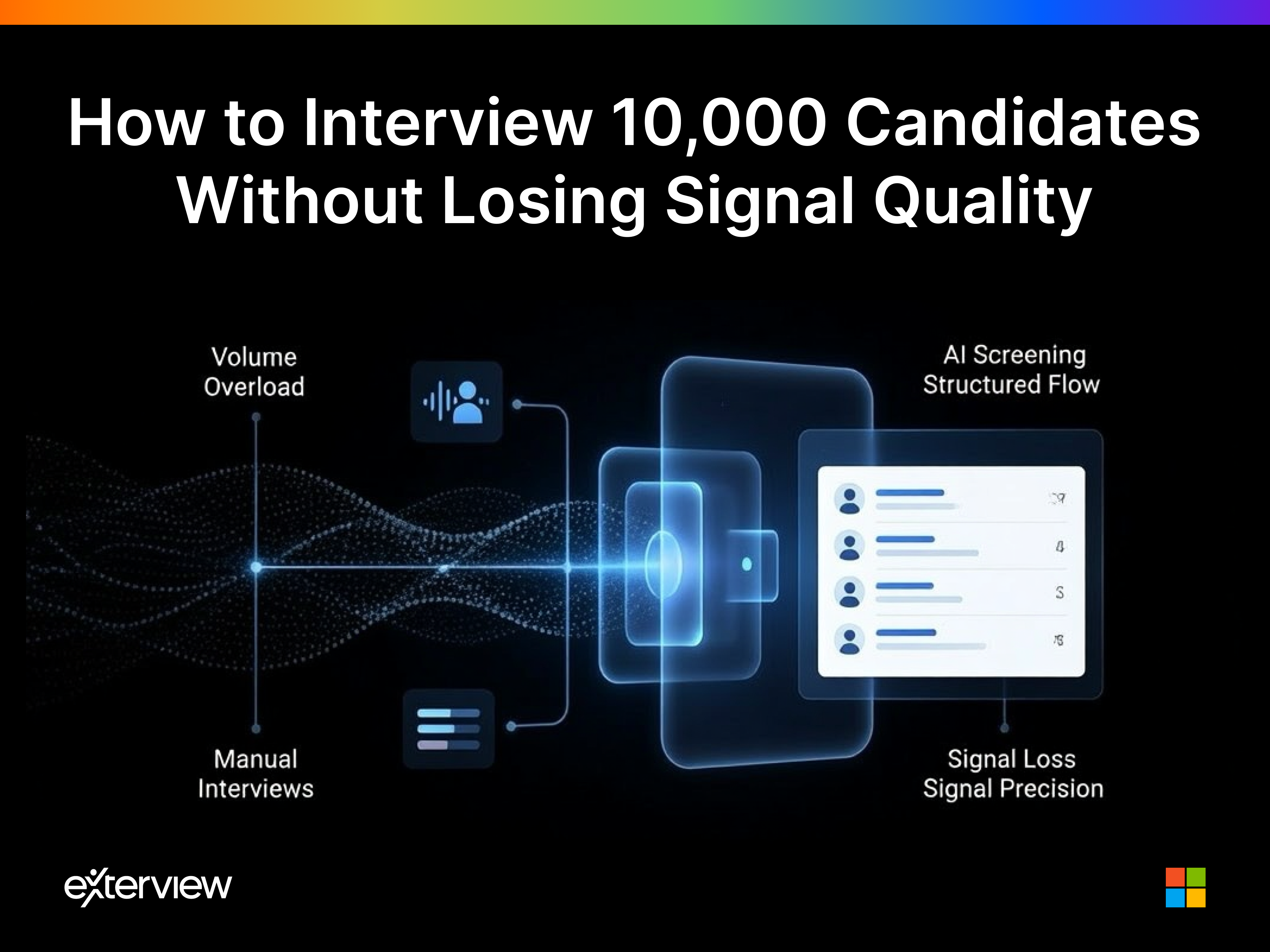
For high-volume hiring, the math quickly becomes impossible. Let's say you have 10,000 candidates for a new role. If you gave each of them a standard 45-minute first-round interview, that's 7,500 hours of interviewing. If you dedicated 100 recruiters to this task, working full-time on nothing else, it would still take over two weeks.
This is the central paradox of scale in recruiting: as candidate volume increases, the quality of human evaluation inevitably decreases. It’s not a lack of effort; it's a lack of capacity. Humans get tired. Our attention spans drift. Subtle biases, like preference for candidates who share our alma mater or a simple good mood after lunch, slip into our judgments. This is where "signal quality", the ability to accurately identify the best candidates begins to collapse.
Traditional methods of filtering, like keyword-scanning resumes, often fail to identify high-potential candidates who lack a precise pedigree. Phone screens are time-consuming and prone to human subjectivity. At the 10,000-candidate level, you aren't just looking for the right person; you're also desperately trying to manage a logistical nightmare. The resulting "signal" becomes noisy, inconsistent, and often, misleading.
This is where a Talent Intelligence OS, powered by artificial intelligence, is changing the landscape of high-volume hiring. The core idea is simple: AI does not replace interviews. It standardizes the first layer of evaluation. It provides the infrastructure to screen large pools of talent with speed and, crucial to this discussion, unmatched signal consistency.
Let's break down how this works and why it can actually improve signal quality, not just manage the volume.
The AI-Powered First Layer: Voice, Avatars, and Analysis
The new first-round interview isn't with a human; it's facilitated by an intelligent system. This can take two primary forms:
- AI Voice Interviews: Candidates receive an invite to a scheduled time. They join a call (often via phone or a web interface) and are prompted by an AI-generated voice that presents a structured series of questions. The AI "listens" to the answers, navigating standard follow-ups and conversational prompts.
- AI Avatar Interviews: This is the visual evolution. A customizable digital avatar, a synthetic "interviewer" appears on a screen. This avatar asks questions, provides encouraging prompts, and can even offer realistic non-verbal cues. This format often feels more like a traditional face-to-face conversation.
In both cases, the entire conversation is recorded. This is where the true power of Talent Intelligence is unlocked. The OS platform doesn't just store the recording; it instantly transcribes the audio and applies sophisticated natural language processing (NLP) to perform an automated analysis.
The Secret to Signal Quality at Scale: Consistency, Structure, and Objectivity
The most significant argument for AI in the first round is that it solves the human inconsistencies that destroy signal quality. Here’s why a high-volume process led by AI is often better at identifying the true top talent than a traditional human process:
1. Structured Questions (The "What"):
In human-led interviews, questions can meander. A recruiter might ask an excellent question of the first five candidates, then get tired or bored and start winging it with the next five. This is the definition of inconsistent signal. AI systems have an uncompromising adherence to a structured protocol. Candidate #1 and candidate #10,000 get the same questions, asked the same way. This means that any difference in their performance is due to their skills, not the quality of the interviewer they were assigned.
2. Consistent Rubrics (The "How"):
A structured interview is only as good as its scoring. This is where bias and fatigue often win. After hearing the same "What is your biggest weakness?" question 50 times in a week, a human recruiter's standard for a "good" answer is guaranteed to drift. AI, however, is trained on specific, validated rubrics. It evaluates an answer’s core components—problem-solving method, logic, depth of example—using the same mathematical formula for every candidate. This eliminates subjective scoring variance and creates a truly level playing field.
3. Unbiased Scoring (The "Who"):
Perhaps the most powerful advantage is the mitigation of human bias. While no system is perfectly objective (AI is trained on human data, after all), a properly engineered Talent Intelligence OS can filter out many of the explicit and implicit biases that plague human decisions. The AI doesn't know what a candidate "looks like" (or can be configured to ignore it). It isn't influenced by a candidate's accent, their zip code, or the gendered tone of their writing. Its scoring is based solely on the substance and quality of the response. This dramatically improves signal quality by focusing exclusively on what matters: ability.
The New Role of the Recruiter: Strategist, Not Sifter
When a Talent Intelligence OS platform is handling the initial 10,000 screens, the entire function of the talent acquisition team transforms. Instead of spending 7,500 hours conducting repetitive first-round calls, they receive a detailed, stack-ranked report of the top candidates.
Recruiters are no longer "sifters," spending months drowning in volume just to find a handful of quality resumes. They become "strategists" and "relationship managers." They can focus their time, energy, and empathy on the high-quality human interactions required for the second and final interview stages—the rounds that require deep-dive behavioral analysis, team-fit assessments, and closing conversations.
Hiring 10,000 people will always be hard. But with AI, it no longer has to mean sacrificing the accuracy of your hiring decisions. By automating and standardizing that first, critical layer of evaluation, organizations can dramatically increase their signal quality, creating a hiring process that is not just faster, but fundamentally fairer and more accurate for every single applicant.