The Future of AI Agents Is Constrained, Not Autonomous
Why the next $100B in enterprise AI will be won by agents that know their limits and prove it.


The industry has fallen in love with a story: AI agents will reason, plan, use tools, and self-correct their way into running entire workflows. Chatbots are out. Autopilots are in. Multi-agent systems will replace org charts.
It's a clean narrative. It's also wrong for the buyers who actually have budget.
The enterprises writing seven and eight-figure checks for AI in 2026, banks, pharma companies, hospital systems, regulated manufacturers are not buying autopilots. They are buying constrained agents: systems that operate with bounded autonomy, schema-pinned outputs, full audit trails, and tenant-specific judgment that compounds over time.
This distinction is not semantic. It is the difference between a demo and a deployment.
The Three Myths of the Agentic Era
Myth 1: Reasoning, tool use, and self-correction are differentiators.
They are not. Every frontier model and every framework LangGraph, CrewAI, AutoGen, Microsoft Agent Framework ships these capabilities out of the box. Claiming "our agent can reason and use tools" in 2026 is like claiming "our SaaS app has a database" in 2016. Table stakes.
The actual moat is domain-grounded judgment: agents that score, decide, and recommend against ground truth specific to a customer's business, not generic LLM heuristics trained on the open web. A hiring agent that has watched 10,000 successful hires at your company with your role rubrics, your compliance constraints, your 90-day retention signals fed back into its scoring is categorically different from an agent that has read the public internet.
This is why the winners will not be the foundation model labs or the orchestration frameworks. They will be the vertical platforms that own the feedback loop the closed system where every decision generates ground truth that sharpens the next decision.
Myth 2: Multi-agent systems are coordinated intelligence.
Most "multi-agent systems" shipping today are sequential pipelines with a router. A planner agent hands off to a research agent, which hands off to a writer agent, which hands off to a reviewer. This is a workflow, not a society of minds.
True multi-agent value emerges only under two conditions: agents with distinct evaluation criteria (so they can disagree productively), and resolution mechanisms for that disagreement (so the system converges on a defensible answer). Without both, you have an expensive Rube Goldberg machine producing the same output a single well-prompted model would produce, slower and at higher cost.
The frameworks rarely talk about this because the hard part is not orchestration. The hard part is designing what each agent is allowed to optimize for, what data it sees, and how conflicts get arbitrated. That is product work, not infrastructure work.
Myth 3: Autopilots are the destination.
In consumer and SMB markets, perhaps. In regulated enterprises, never. A pharma company governed by GxP, a bank under SR 11-7, a hospital under HIPAA none of these can deploy a system that takes irreversible actions without a human checkpoint and a tamper-evident audit log. The compliance posture is not a bolt-on. It is the architecture.
The winning pattern is constrained autonomy: agents that operate freely inside a tightly defined action space, surface decisions with confidence scores and rationale, and route anything outside their bounded competence to a human. The agent does not replace the operator. It compresses the operator's surface area from 100 decisions to the 10 that actually require judgment.
What Constrained Agentic Architecture Actually Looks Like
Five properties separate constrained agents from the autopilot fantasy:
- Schema-pinned outputs. Every agent decision is validated against a contract before it touches a database, an API, or a human inbox. No free-form prose into systems of record.
- Tenant-partitioned memory. Each customer's ground truth, scoring rubrics, and feedback signals are isolated. Cross-tenant learning is a liability, not a feature, in regulated verticals.
- Eval-first, not prompt-first. Every prompt has a pinned evaluation harness golden datasets, regression tests, drift monitors. Prompts are versioned artifacts, not strings in code.
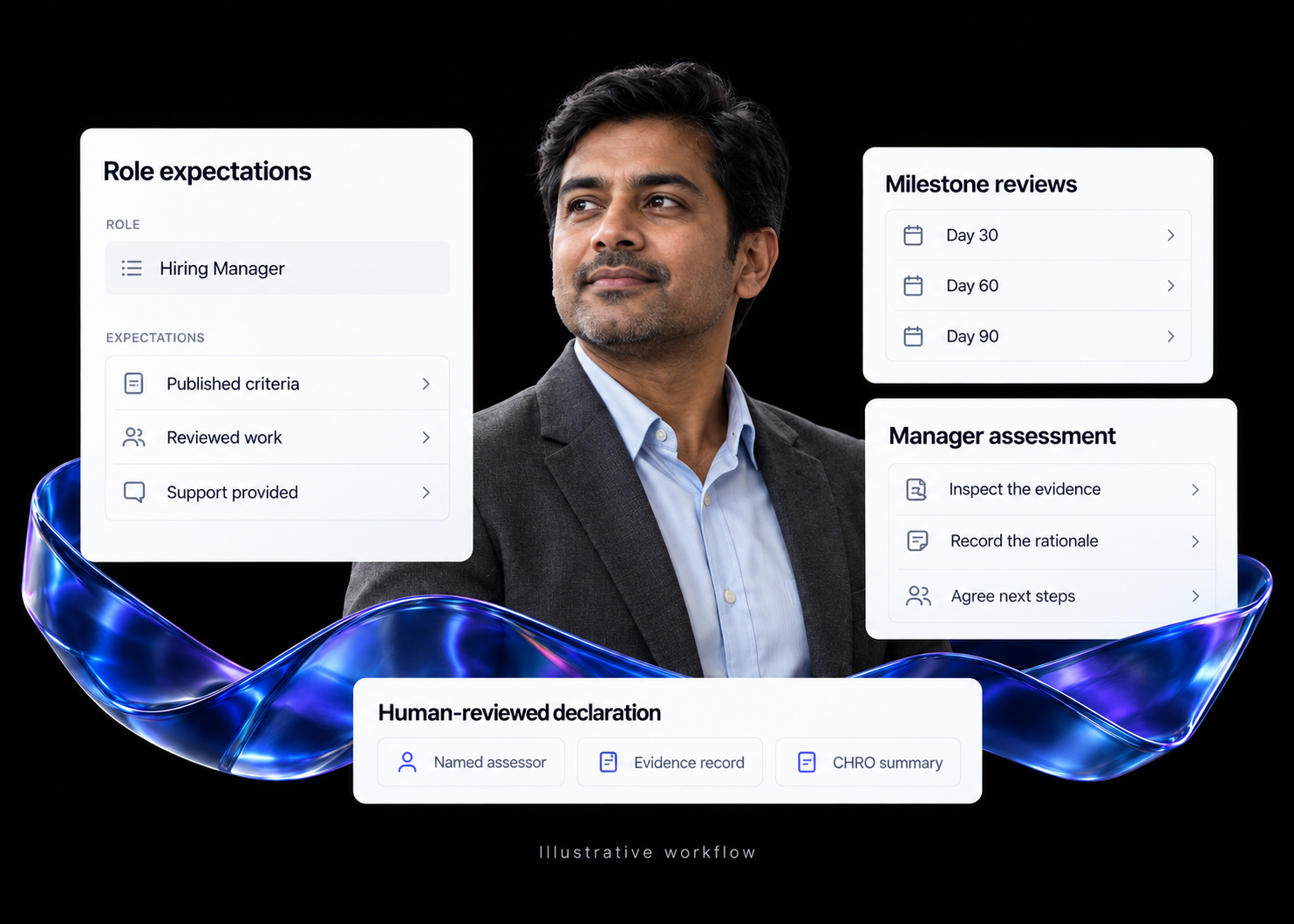
- Human checkpoints by design. The architecture explicitly defines which decisions are agent-final, which are agent-recommended-human-approved, and which are human-only. This is a product decision, not a UX afterthought.
- Compounding feedback loops. Every downstream outcome a hire that worked, a loan that defaulted, a diagnosis that was correct, flows back into the scoring layer. The system gets sharper with each cycle. Without this loop, the agent is frozen at deployment.
Why This Matters for Where Capital Is Flowing
The horizontal agent layer, the orchestration frameworks, the agent IDEs, the generic "agent for everything" platforms is going to commoditize fast. Microsoft, Google, AWS, and the foundation labs will absorb most of that value into their platforms. The arbitrage closes.
The durable value accrues to vertical platforms that:
- Own a regulated workflow end-to-end.
- Generate proprietary ground truth no foundation model can replicate.
- Compound that ground truth into scoring systems that sharpen per tenant.
- Ship inside the compliance perimeter (SOC 2, ISO 27001, ISO 42001, HIPAA, DPDP, EU AI Act) on day one, not as a roadmap item.
This is the thesis behind every defensible AI company being built right now in BFSI, pharma, healthcare, legal, and regulated industrials. Not "we have agents." Everyone has agents. We have constrained agents that get smarter with every customer decision, inside the audit boundary the buyer already trusts.
The Bet
The next decade of enterprise AI will not be won by the most autonomous systems. It will be won by the most trustworthy ones agents that know what they are allowed to decide, prove what they decided, and improve every time the world tells them they were right or wrong.
Autonomy is easy to demo. Constrained autonomy is hard to build, harder to deploy, and the only thing regulated buyers will sign for.
That is the category. That is where the compounding lives. That is where the next generation of vertical AI platforms will be built.
Exterview AI is building the Agentic Talent Intelligence Platform for regulated enterprises in BFSI, Pharma, and Healthcare a 9-agent architecture that ships inside the compliance perimeter and compounds judgment with every hiring decision.

Manish Surapaneni