AI Hiring for Pharmaceutical Manufacturing: Why Shopfloor Evaluation Requires Agentic Intelligence
GMP compliance, documentation discipline, and dexterity — signals no ATS was built to evaluate.

Most hiring problems are problems of volume. Too many applications, too little time, too few qualified people to review them. The solution, in most industries, is some combination of better filtering, faster screening, and smarter prioritisation. The problem gets solved at the top of the funnel.
Pharmaceutical shopfloor hiring is not that problem. It is a fundamentally different one, and the reason most hiring technology fails to solve it is that it was never designed with this environment in mind.
The Regulatory Layer Changes Everything
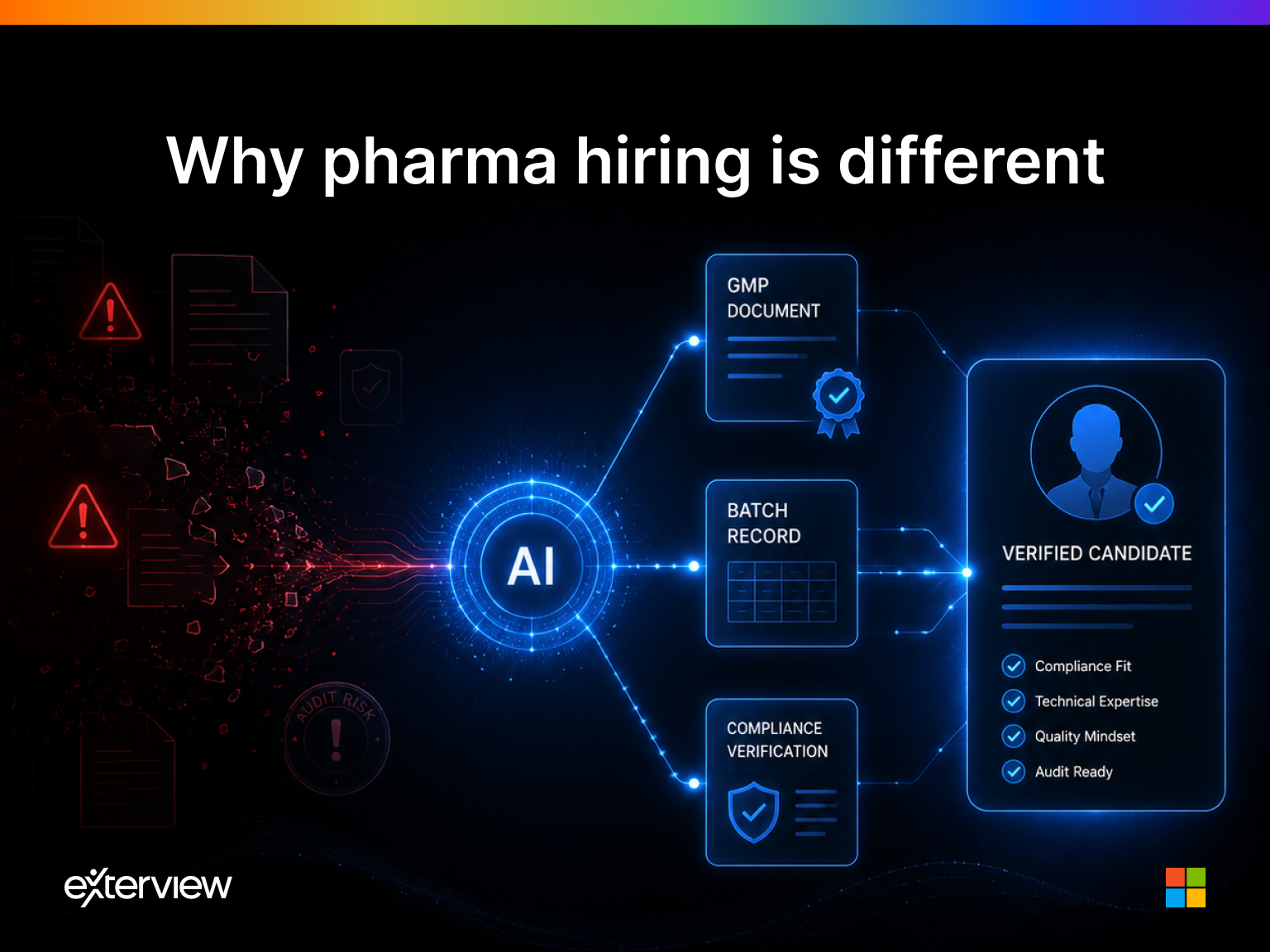
In most industries, a bad hire is a performance problem. In pharmaceutical manufacturing, a bad hire is a compliance event. Every individual on the production floor operates within a framework of regulatory obligations, Good Manufacturing Practice documentation standards, equipment qualification protocols, batch record accuracy requirements, and chain-of-custody traceability that does not pause for human error. A candidate who cannot maintain contemporaneous documentation does not just underperform. They create audit findings. In USFDA-regulated facilities, audit findings have consequences that extend well beyond the individual: warning letters, consent decrees, facility shutdowns, and product recalls are all downstream of human error at the point of production.
This means that the evaluation of shopfloor candidates in pharmaceutical manufacturing must do something that general-purpose hiring tools are not designed to do: it must assess regulatory literacy as a core competency, not as a secondary preference.
Regulatory literacy is not a checkbox. It is not confirmed by asking whether a candidate has worked in a pharma environment before. It manifests in how a candidate describes their documentation practice whether they understand the difference between making a contemporaneous entry and filling in a batch record at the end of a shift. It appears in how they respond to a scenario question about a deviation: whether their instinct is to document first or to correct first. It shows in their understanding of why quarantine status labelling matters, not just that it does.
No resume reveals this. No ATS flag captures it. It requires structured, domain-specific, real-time evaluation, and that is precisely what most hiring pipelines in manufacturing do not have.
The Technical Depth Is Non-Negotiable and Non-Transferable
A second dimension of the problem is the depth of technical knowledge required for what are often entry-to-mid-level roles. This creates an evaluation paradox that is unique to pharmaceutical manufacturing.
In most industries, a candidate at the entry or mid level is evaluated on potential and trainability. The assumption is that the organisation will provide the domain knowledge. In pharmaceutical shopfloor roles, that assumption fails, because the regulatory environment requires that the person operating the equipment understands what they are doing well enough to document it accurately in real time. You cannot train CGMP discipline into a person who has never worked in a regulated environment during the first week of their employment. The documentation requirements begin from day one.
This means the evaluation must distinguish, at the point of hiring, between candidates who have genuine working knowledge of the relevant process wet granulation endpoint determination, or dry milling parameter validation, or coating weight variance control and candidates who have surface familiarity. The distinction is consequential. A candidate who knows the terminology but not the underlying process will produce documentation that passes a casual review and fails an audit.
The challenge is that this level of technical evaluation requires the kind of structured, scenario-based questioning that most HR teams are not equipped to conduct consistently. A skilled production manager can distinguish between genuine and surface knowledge in a ten-minute conversation. An HR officer running fifteen screening calls in a single day cannot reliably make the same distinction not because they are less capable, but because the conditions under which the evaluation is happening make consistency structurally impossible.
Scale Breaks the Evaluation Model
Pharmaceutical manufacturing facilities that operate at enterprise scale multiple production units, multiple shifts, multiple product lines, hire for shopfloor roles in volumes that dwarf the capacity of structured manual evaluation. A single product launch or expansion can require the simultaneous evaluation of several hundred candidates across multiple role types, each requiring domain-specific assessment.
At that scale, the inconsistency problems inherent in manual evaluation are not just inconvenient, they are compounding. Every candidate evaluated differently from the last introduces noise into the selection process. Noise in the selection process translates to variance in the quality of hires. Variance in the quality of hires, in a regulated environment, translates to compliance risk distributed across the production floor.
The conventional response to this problem is to hire more evaluators. But more evaluators means more variability, not less. Inter-rater reliability in unstructured evaluation is low even when evaluators are well-trained and well-motivated. Adding evaluators to a process that lacks a consistent evaluation framework scales the problem, not the solution.
The Behavioural Layer Is as Critical as the Technical One
What makes pharmaceutical shopfloor hiring uniquely difficult is that it requires simultaneous assessment of two dimensions that are genuinely independent of each other: technical competency and behavioural suitability.
A candidate can be technically excellent, deep process knowledge, strong documentation discipline, genuine regulatory literacy, and still be a poor hire for a manufacturing environment that operates on rotating shifts, with cross-functional team dependency, in a culture where adherence to procedure is non-negotiable regardless of individual preference. Conversely, a candidate who is behaviourally ideal, stable, collaborative, long-tenure oriented, high learning agility, may lack the technical foundation to operate in a regulated environment without creating compliance risk during the ramp period.
The problem is that these two dimensions are assessed through completely different channels in most hiring processes. Technical knowledge is evaluated through a domain-specific interview, often conducted by a production manager with limited capacity. Behavioural suitability is assessed through an HR screening, often conducted by an officer who lacks the technical reference point to connect behavioural signals to role-specific risk.
The result is that the two evaluations happen in isolation, are rarely synthesised into a composite picture before a hiring decision is made, and frequently produce contradictory signals that default to whoever in the organisation has the final sign-off, which may or may not be the person with the most complete view of the candidate.
What a Structured Evaluation Architecture Looks Like
Solving the pharmaceutical shopfloor hiring problem requires an evaluation architecture that was built for this specific environment, not adapted from a general-purpose hiring tool.
That architecture must assess technical competency at the level of granularity the role requires, not whether the candidate has pharma experience, but whether they can describe the specific process steps, parameter controls, and documentation requirements of the function they are being hired for. It must assess behavioural suitability through a structured framework that is consistent across every candidate and every evaluator. It must synthesise both dimensions into a composite recommendation that is explainable, auditable, and does not require the hiring manager to hold two separate evaluation outputs in their head while making a decision.
It must do this consistently, not on the fifteenth candidate of the day the same way it does on the first. It must do it at scale, across hundreds of candidates in a hiring drive without the quality of evaluation degrading as volume increases. And it must produce an audit trail, a timestamped, versioned record of how every candidate was evaluated, what they said, how it was scored, and why a recommendation was made.
This is not a description of the future of pharmaceutical hiring. It is a description of what the problem requires now, and what the organisations that solve it first will hold as a structural advantage over those that continue to evaluate their most compliance-critical workforce with tools designed for a different problem entirely.

Manish Surapaneni