The Hidden Cost of a Bad Hire Nobody Measures
Bad hires cos far more than hiring itself and most of it goes unseen

The Hidden Cost of a Bad Hire Nobody Measures
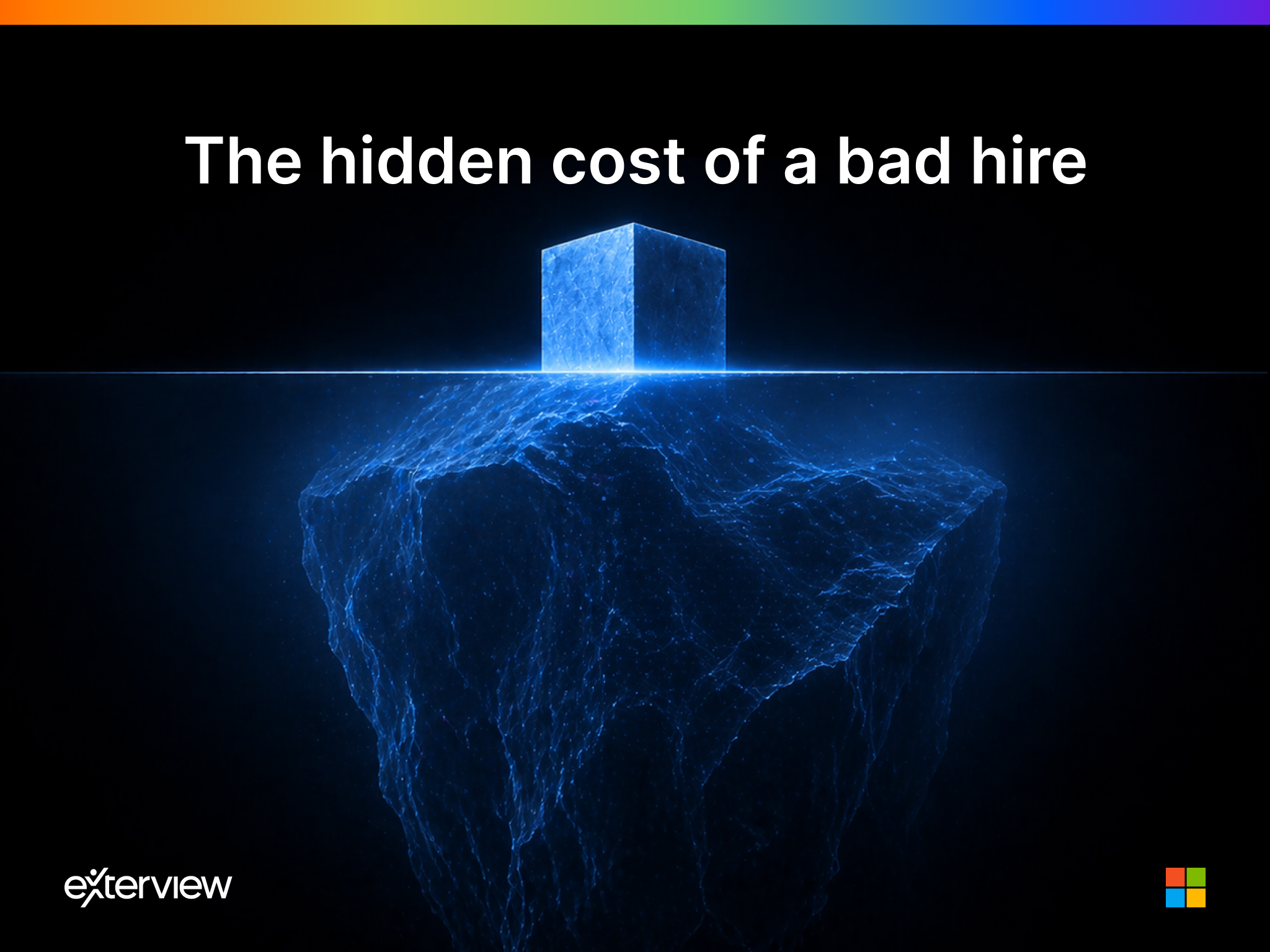
Every CFO in a Fortune 500 company knows their cost per hire. Almost none of them know their cost per bad hire. And the gap between those two numbers is where a significant and largely invisible drain on enterprise value is hiding.
Cost per hire, the recruiter fees, job board spend, interview hours, and onboarding costs associated with filling a role is a well-tracked metric. It averages $4,700 for hourly roles and climbs to $28,000 or more for senior technical and leadership positions. It appears in HR dashboards. It gets optimized in quarterly recruiting reviews.
Cost per bad hire is different. It is not tracked. It is not reported. It is absorbed across teams, quarters, and business units in ways that make it effectively invisible. And according to the best available research, it is between six and twenty times larger than the cost per hire that everyone is focused on.
The Anatomy of a Mis-Hire
A bad hire does not announce itself on a balance sheet. It distributes its cost across five categories, each partially visible, each typically attributed to something other than the original hiring decision.
Direct replacement costs. When a mis-hire leaves or is managed out, the full recruiting cycle begins again. Search fees, interview time, offer negotiation, onboarding, and ramp time are incurred twice for one role. For a senior engineering position with a $180,000 base salary, this alone can exceed $90,000.
Productivity loss. The period from hire to full productivity, the ramp curve typically runs three to six months for individual contributors and six to twelve months for managers and leaders. A mis-hire who exits at month eight has consumed the full ramp investment while producing below-expected output. That productivity loss is booked as team underperformance, not hiring cost.
Team drag. A mis-hire in a collaborative role does not just underperform individually. They reduce the performance of the people around them. Research from the National Bureau of Economic Research suggests that a single low-performing team member can reduce team output by 30 to 40 percent. This drag is distributed across team members’ performance reviews, project timelines, and manager attention never attributed to the hiring decision that caused it.
Management time. Managing a struggling hire consumes disproportionate manager bandwidth, additional coaching, performance documentation, difficult conversations, HR coordination. Harvard Business Review research suggests that managers spend up to 17 percent of their time managing underperformers. This is time not spent on strategy, development, or the high-performers who deserve attention.
Cultural cost. The hardest to quantify and the most enduring. A bad hire in a leadership role can reshape team dynamics, drive out strong performers who disengage, and create organizational patterns that persist long after the original mis-hire is gone. This cost is measured in regrettable attrition, engagement survey scores, and the institutional knowledge that walks out the door with frustrated high performers.
The Number Nobody Wants to Calculate
The U.S. Department of Labor estimates the cost of a bad hire at 30 percent of annual salary. That is the conservative estimate, applied to the most straightforward cases. For senior and leadership roles, independent research from the Society for Human Resource Management puts the figure at 50 to 60 percent of first-year compensation. For C-suite and VP-level positions, the fully-loaded cost including search fees, opportunity cost, and cultural recovery can exceed 213 percent of annual salary.
Apply these numbers to an enterprise that makes 500 hiring decisions per year with a 15 percent mis-hire rate, a conservative estimate for most large organizations and the annual cost of hiring failure exceeds the annual budget of most HR technology deployments by a factor of ten or more.
This is money that is being spent. It is simply not being attributed correctly.
Why the Measurement Gap Persists
The reason this cost goes unmeasured is not ignorance. It is attribution complexity. Mis-hire costs are distributed across accounting categories, recruiting, compensation, team productivity, management overhead that have no natural aggregation point. No system connects the dots between a hiring decision made in Q1 and a performance outcome measured in Q3 and a regrettable attrition event that occurs in Q4 of the following year.
The ATS records the hire. The HRIS records the exit. Nothing in between tracks the trajectory and connects it back to the evaluation quality that predicted it.
This is precisely the measurement gap that a scored, structured intelligence layer closes. When every hiring decision is accompanied by a structured evaluation record, competency scores, behavioral signal, benchmark comparison, prediction confidence, the outcome can be traced back to the input. The system can tell you not just that a hire failed, but which evaluation signals should have predicted that failure and whether the interview process captured them.
The ROI Calculation That Changes the Conversation
When enterprise technology buyers evaluate talent intelligence platforms, they typically frame the ROI around efficiency: time-to-hire reduction, recruiter productivity, cost-per-hire optimization. These are real and meaningful benefits.
But they are small compared to the ROI available from mis-hire reduction.
A platform that reduces the mis-hire rate by five percentage points from 15 percent to 10 percent across a 500-hire-per-year enterprise saves more in avoided mis-hire cost than the typical HR technology budget in its entirety. This is not a rounding error. It is the primary value driver, and it is systematically underweighted in every ROI conversation because nobody has been measuring the baseline cost it displaces.
The hidden cost of a bad hire is not hidden because it is small. It is hidden because nobody built the system to make it visible.
That system now exists.
Exterview generates the structured hiring signal that connects evaluation quality to business outcomes making the cost of hiring failure visible, measurable, and preventable.

Manish Surapaneni