The Hidden Cost of Interviewer Bias at Scale
Interviewer bias at scale becomes a systemic issue that reduces hiring quality and slows growth


The Hidden Cost of Interviewer Bias at Scale
In the race to build high-performing teams, most organizations treat "interviewer bias" as a HR box to be checked, a series of sensitivity training sessions or a slide deck on "unconscious pitfalls." But for a scaling enterprise, bias isn’t just a social friction point; it is a silent, systemic tax on growth.
At Exterview, we view talent through the lens of a Talent Intelligence OS. When you look at the data, a startling reality emerges: Bias is not just a human problem. When left unchecked, it becomes a structural failure that compounds as you grow.
The Mathematics of Compounded Bias
When a startup is small, a single biased interviewer might miss one great candidate. It’s a loss, but it’s contained. However, as an organization scales to hiring hundreds or thousands of people monthly, that individual bias doesn’t just stay linear. It multiplies.
Imagine a hiring funnel where ten different interviewers each have a slight, unconscious preference for candidates from their own alma mater or those who share a similar communication style. If each stage of your funnel has a "bias leakage" of just 10%, by the time you reach the final offer stage, your talent pool has been mathematically "filtered" for homogeneity rather than high-performance signals.
This is the Hidden Tax of Scale. You aren’t just losing diversity; you are losing the very "top-of-funnel" excellence you spent thousands of dollars in marketing and sourcing to acquire.
From Human Error to Systemic Failure
We often talk about "gut feelings" as a positive trait in experienced recruiters. In reality, the "gut" is often just a repository for pattern recognition that favors the familiar. When an organization lacks a unified intelligence layer, these "guts" operate in silos.
Without a standardized evaluation framework, "Cultural Fit" becomes a catch-all for "People Like Me."
When bias is baked into the process, the cost manifests in three specific ways:
- Increased Time-to-Hire: Biased interviewers often hold out for a "perfect" (familiar) candidate, ignoring qualified talent that doesn't fit the mold.
- High Early Attrition: When people are hired based on affinity rather than objective competency, the "skill-gap" eventually surfaces, leading to turnover within the first six months.
- Innovation Stagnation: Homogeneous teams solve problems in the same way. The cost of a missed "out-of-the-box" thinker is impossible to calculate but felt in every quarterly product cycle.
The Architecture of Objectivity: The Talent Intelligence OS
To solve bias at scale, we must move beyond "awareness" and into architecture. You cannot train bias out of humans entirely, but you can build systems that make bias visible and, eventually, irrelevant.
At Exterview, we believe the solution lies in three pillars of Talent Intelligence:
1. Decoupling the "Who" from the "What"
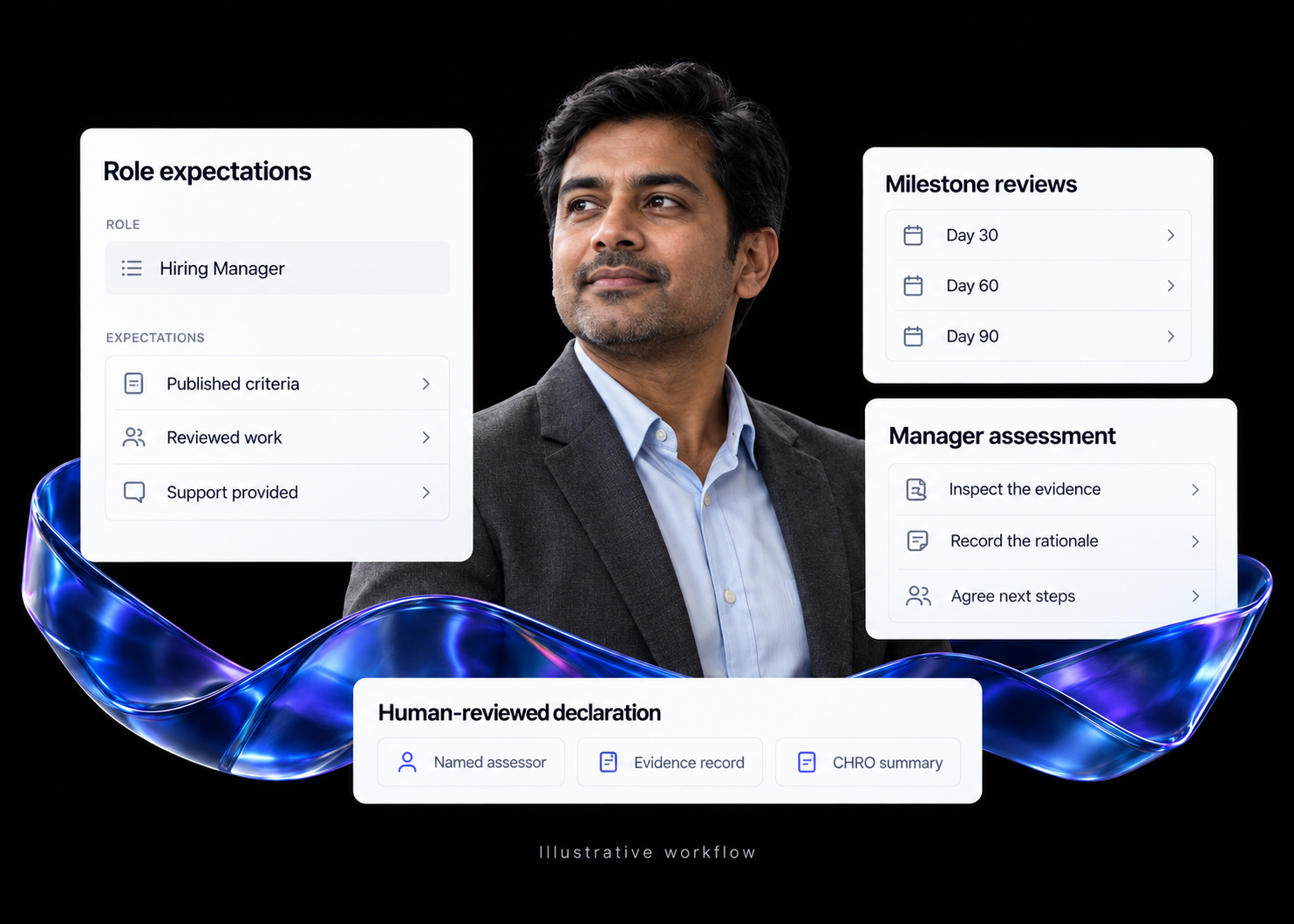
By using AI-driven evaluation frameworks, we can separate a candidate’s performance from their persona. An OS-level approach allows for structured interviews where every candidate is asked the same questions, and their answers are scored against objective rubrics, not the interviewer's mood or the coffee they just had.
2. Real-time Calibration
Traditional hiring involves a "debrief" days after the interview, where memories are hazy and "recency bias" takes over. A Talent Intelligence OS captures data in the moment. It flags when an interviewer is consistently scoring a specific demographic lower than the average, allowing for mid-flight correction rather than post-mortem regret.
3. Evidence-Based Decision Making
The final hiring decision should be a synthesis of data points, not a vote of confidence. By treating the interview as a data-generation event, Exterview transforms subjective conversations into structured insights.
The ROI of Unbiased Hiring
Removing bias isn't just "the right thing to do". It is an aggressive fiscal strategy. Companies that utilize a structured, intelligence-led hiring process see a documented decrease in turnover and a significant spike in "Quality of Hire" metrics.
When you remove the noise of bias, you are left with the signal of Competency.
For the modern enterprise, the goal shouldn't be to "reduce bias." The goal should be to build a High-Fidelity Talent Pipeline. Every time an interviewer chooses "likability" over "capability," the company's valuation takes a microscopic hit. Over a thousand hires, those hits add up to a catastrophic loss of competitive advantage.
Conclusion: The Future is Intelligence, Not Instinct
The era of "hiring by instinct" is closing. As organizations transition to becoming truly global and remote-first, the complexity of human interaction is too high to manage with 20th-century HR tools.
The hidden cost of interviewer bias is the difference between a company that survives and a company that leads. By implementing a Talent Intelligence OS like Exterview, you aren't just fixing a "people problem". you are optimizing your most expensive and valuable asset: your human capital.
Don't let your scale become your weakness. Turn your hiring process into a source of objective truth.

Manish Surapaneni