Why High-Volume Hiring Breaks Traditional ATS Systems
Traditional ATS fails in high volume hiring as it focuses on tracking not talent evaluation

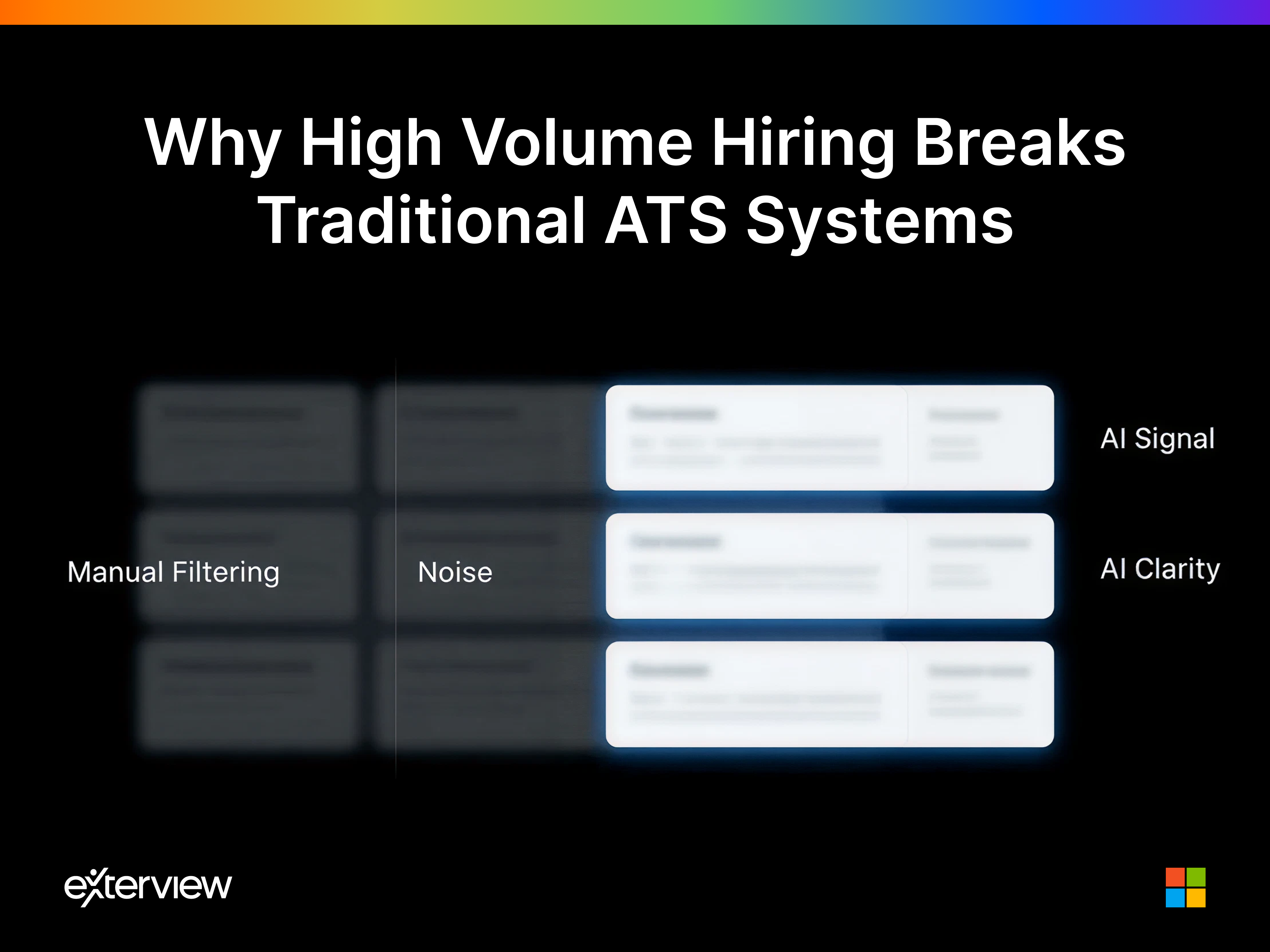
In the world of talent acquisition, there is a fundamental misunderstanding about what a Record-Keeper can do versus what a Decision-Maker needs.
For the better part of two decades, the Applicant Tracking System (ATS) has been the undisputed king of the HR tech stack. It was designed to solve a specific, administrative problem: the transition from paper resumes to digital databases. And it did that job well. But as we enter an era defined by rapid-scale growth and AI-driven applications, a harsh reality is setting in for enterprise leaders:
Your ATS wasn't built to find the best talent; it was built to house it.
When hiring volume moves from a steady trickle to a flood, the traditional ATS doesn't just slow down, it breaks. Here is why the "Tracking" era is ending, and the "Intelligence" era is becoming a survival requirement.
1. The Bottleneck: Recruiters as Human Filters
In a traditional workflow, the ATS acts as a massive digital filing cabinet. When 5,000 candidates apply for 50 roles, the burden of "first-pass" filtering falls entirely on human shoulders.
Recruiters are forced to play a high-stakes game of "Keyword Bingo," spending an average of six seconds per resume. In high-volume scenarios, this creates a massive bottleneck. The faster the applications come in, the more the quality of review degrades. Valuable talent is often discarded simply because a human eye was too fatigued to find the nuance behind a bullet point.
2. The "Signal-to-Noise" Collapse
Traditional ATS systems rely on structured data such asnames, dates, and job titles. However, these are poor proxies for actual capability.
In high-volume hiring, the "noise" (unqualified applicants) often drowns out the "signal" (top performers). Because an ATS lacks the native intelligence to evaluate technical skills or behavioral competencies at the point of entry, it treats every application with equal weight.
This leads to "Pipeline Bloat." Your team spends 80% of their time talking to the bottom 20% of the candidate pool, simply because the system can’t tell the difference between a candidate who says they can code and a candidate who actually can.
3. The Inconsistency Plague
When volume grows, the number of interviewers must grow with it. This is where the ATS’s lack of evaluative framework becomes a liability.
Without a Talent Intelligence OS sitting on top of the workflow, interviews become a "Choose Your Own Adventure" game. Different managers ask different questions, use different rubrics, and rely on "gut feeling."
- ATS approach: Stores the "Pass/Fail" notes.
- The Result: A fragmented data set where hiring decisions are based on likability rather than capability.
4. The Candidate Experience Death Spiral
In a high-volume environment, the "Black Hole" effect is real. When an ATS is overwhelmed, communication is the first thing to go. Candidates wait weeks for a response, only to receive a generic rejection email or worse, nothing at all.
In a competitive market, top-tier talent won't wait. If your system can't identify and fast-track them within 48 hours, they will be hired by a competitor who isn't bogged down by manual status updates.
From "Tracking" to "Intelligence": The Exterview Shift
At Exterview, we believe that the solution isn't a better filing cabinet; it’s a brain that sits on top of it. A Talent Intelligence OS transforms high-volume hiring from a logistical nightmare into a competitive advantage by solving the three core failures of the ATS:
Scaling Evaluation, Not Just Storage
Exterview doesn't just "track" an applicant. It uses AI-driven technical assessments and video intelligence to evaluate capability the moment a candidate applies. We move the "evaluation" to the front of the line, ensuring that recruiters only spend time with candidates who have already proven they can do the job.
Standardizing the "Human" Element
By providing structured, data-driven interview insights, we remove the "gut feeling" bias. Whether you are conducting 10 interviews or 1,000, the criteria for success remain identical. This creates a fair, defensible, and highly predictive hiring process.
Eliminating the Manual Grind
Automated workflows handle the scheduling, screening, and feedback allowing your recruitment team to act as talent advisors rather than data entry clerks.
If your organization is planning to scale, relying solely on a traditional ATS is like trying to manage a modern city's traffic with a single stoplight. It’s not just inefficient; it’s a risk to your growth.
The future of hiring isn't about who can track the most applicants. it's about who can find the most talent in the shortest amount of time. It's time to move beyond the ATS and embrace a Talent Intelligence OS.

Manish Surapaneni