Why Internal Interviews Cannot Scale The Case for Structured Hiring Intelligence
Why structured interviews fail a scale and create inconsistent hiring decisions

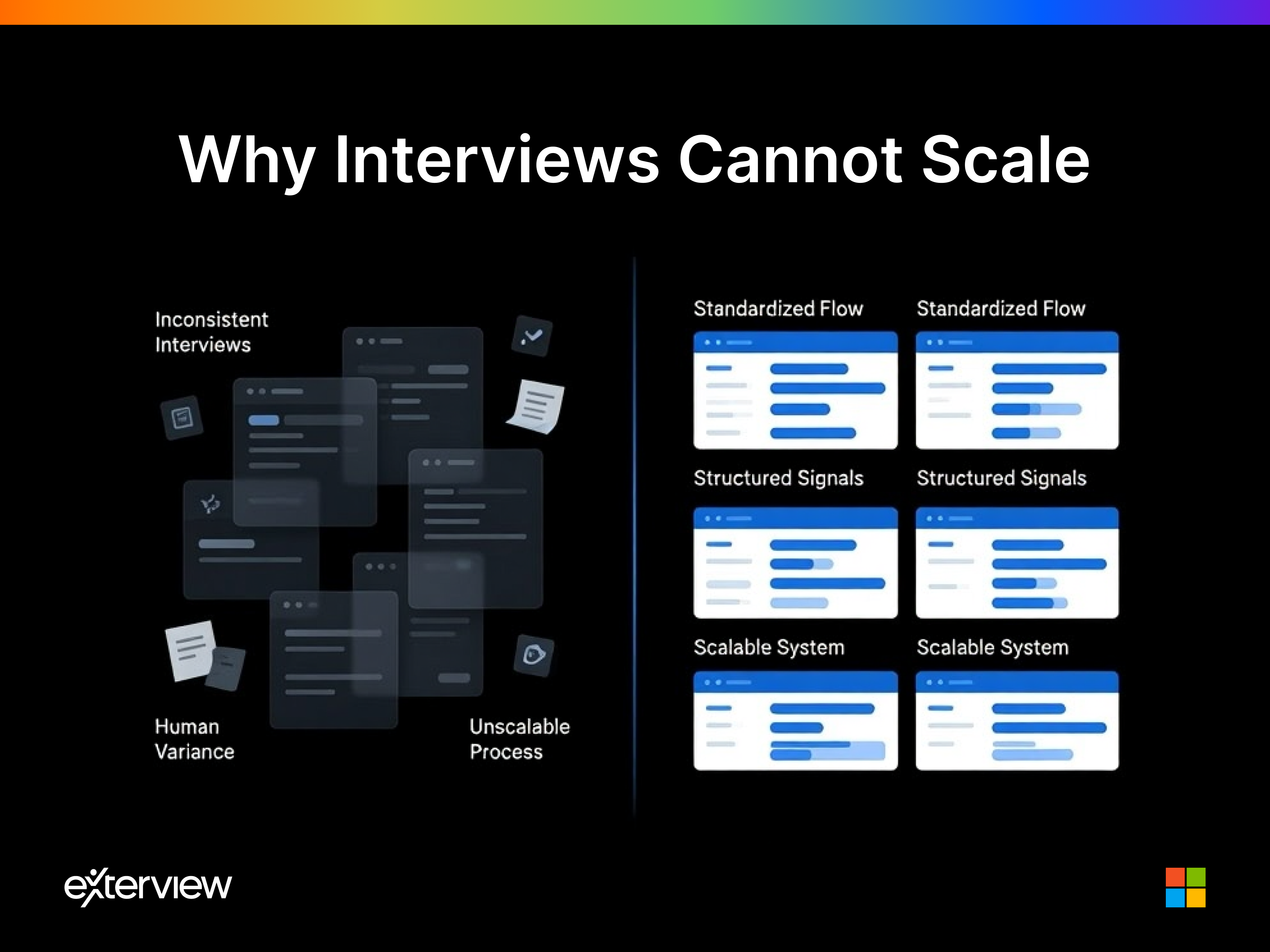
Imagine asking 50 different chefs to judge a cooking competition, each using their own recipe, their own scoring system, and their own definition of "delicious." At the end, you compile the scores and try to decide a winner. The result is not a decision. It is an argument.
This is precisely what happens inside most enterprise hiring processes today. The interview, the oldest and most trusted instrument in talent acquisition, has become the single biggest source of noise in the hiring pipeline.
The Interview Is Not the Problem. The Lack of Structure Is.
Let us be direct: human judgment is not the enemy of good hiring. Contextual intuition, cultural read, and leadership presence are real signals that matter. The problem is not that humans interview. The problem is that most organizations have never systematically engineered their interview process.
Across most enterprise hiring functions, interviews operate on three dangerous defaults:
- Unstructured questioning: Each interviewer brings their own favorite questions, biases, and conversational style. The result is a set of evaluations that cannot be compared.
- Subjective scoring: Ratings like "strong yes" or "leaning no" have no shared definition. One manager's 4/5 is another's 2/5.
- No signal aggregation: Individual feedback is collected but never synthesized. The final hiring decision often goes to whoever spoke last, or whoever spoke loudest.
The consequence is not just inconsistency. It is systematic information loss. Your pipeline generates enormous signal about every candidate. Almost none of it is captured in a usable form.
Why This Cannot Scale
In low-volume hiring, say, five roles per quarter. These problems are manageable. Informal consensus works when the group is small and the stakes are contained. But the moment your hiring volume grows, every structural weakness multiplies.
Consider what happens at scale:
- Interviewer fatigue sets in. When a single recruiter or hiring manager is running 20 to 30 interviews per week, the quality of their assessment degrades measurably by day three.
- Calibration becomes impossible. With 15 interviewers across three offices evaluating the same role, there is no shared rubric, no common baseline, and no reliable way to compare candidates across panels.
- Scheduling becomes a constraint. Coordinating 5-round interview loops across time zones for 200 active candidates is not a talent problem. It is a logistics problem masquerading as one.
- Data quality collapses. The further you scale, the more your hiring data looks like noise. Feedback notes are sparse, scoring is inconsistent, and outcome data. whether the hire succeeded is almost never linked back to the interview signal that predicted it.
At enterprise scale, the unstructured interview is not just inefficient. It is a risk to hiring quality.
The Cost of Unstructured Evaluation
Organizations rarely calculate the true cost of interview inefficiency. They measure time-to-hire and offer acceptance rates. They do not measure signal quality per interview, evaluator consistency scores, or the correlation between interview outcomes and 90-day performance.
This is where the financial damage hides.
- A bad hire at a senior individual contributor level can cost 1.5 to 3x the annual salary in lost productivity, rehiring, and team disruption.
- Interview loops that generate no usable comparative data waste recruiter time that could be redirected toward strategic sourcing.
- Candidate experience degrades when feedback timelines stretch from days to weeks which is leading to drop-off among the strongest candidates, who have the most competing options.
The interview is expensive not because it takes time. It is expensive because the information it generates is rarely captured, structured, or acted upon.
What a Structured System Changes
The answer is not to eliminate human interviews. The answer is to engineer the conditions under which they operate and to build the intelligence layer that captures what they generate.
A structured hiring intelligence system does three things that informal interview processes cannot:
First, it standardizes the evaluation framework. Every interviewer operates from a shared rubric. Questions are calibrated to the role. Scoring criteria are defined before the first interview begins, not improvised after the last one ends.
Second, it captures structured signal. Not just pass/fail notes. Scored behavioral competencies, response quality ratings, confidence levels, and comparative candidate rankings, all linked to the specific role requirements that triggered the interview.
Third, it connects interview signal to hiring outcomes. Over time, the system learns which interview signals actually predicted success. Which questions separated high performers from average ones. Which panel compositions were most accurate. This is not just data collection. It is institutional memory.
The Shift: From Interviews as Events to Interviews as Intelligence
Most organizations treat the interview as an endpoint. A candidate passes or fails. The decision is made. The data is filed and forgotten.
The most forward-looking talent organizations are beginning to treat interviews as the richest data source in the entire hiring pipeline. one that, if properly structured and analyzed, can drive not just individual hiring decisions but continuous improvement of the entire process.
This is what Exterview is built to enable. Not a replacement for human judgment. But the system that makes human judgment consistent, comparable, and continuously smarter.
Your interviewers are generating signal every single day. The question is whether your system is intelligent enough to hear it.
Exterview is the Hiring Intelligence platform that transforms interview signal into hiring decisions at any scale.

Manish Surapaneni