Forward Deployed Recruiter: A New Operating Model for Enterprise Hiring by ExterviewAI
Discover how the FDR model combines human judgment and AI agents to scale hiring with quality and accountability.

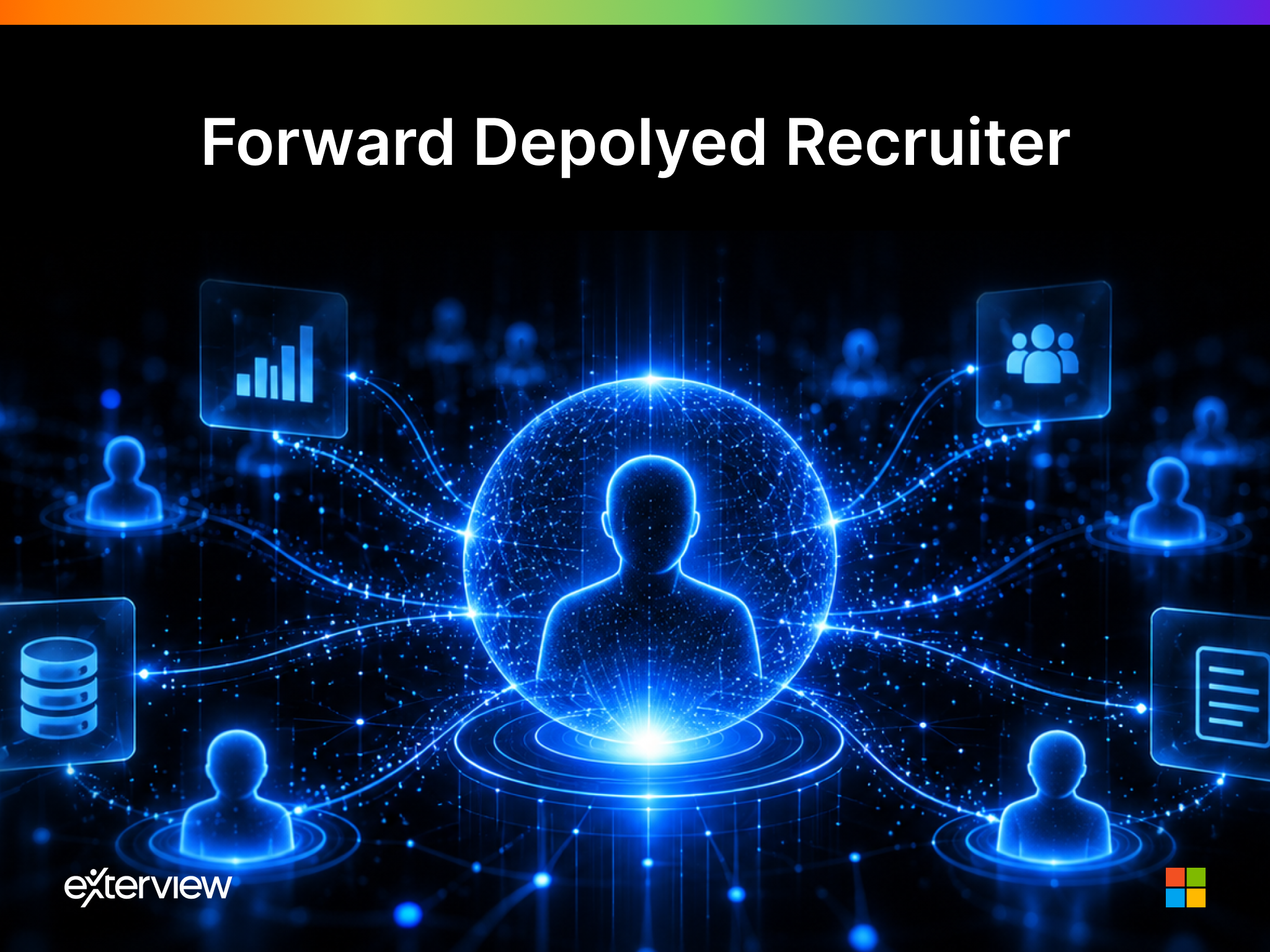
Forward Deployed Recruiter: A New Operating Model for Enterprise Hiring by ExterviewAI
An FDR is not a staffing agency, or an RPO desk and or a chatbot. An FDR works inside a client's hiring team, partners directly with the CHRO and business leaders, runs AI hiring agents, and is accountable for hiring outcomes.
What/Who is a Forward Deployed Recruiter (FDR)?
FDR is a new operating model we are building with our early enterprise partners, designed around the objectives of CHROs and Global Capability Center (GCC) leadership teams are measured on. An FDR is an embedded hiring operator who combines human judgment with AI agents. They sit with your hiring managers, learn your roles and culture first-hand, and run Exterview's agents to source, screen, interview and rank candidates.
The idea comes from engineering. Palantir pioneered the forward deployed engineer: an engineer placed inside the customer's environment to make the product work where it matters. We are applying the same principle to hiring. The recruiter moves from outside the team to inside it, and the platform does the volume work.
An FDR is not a staffing agency, or an RPO desk and or a chatbot. It is a person who owns your hiring results, backed by AI.
How do FDRs add value to growing teams?
The FDR model is still evolving. However, the outcomes it targets (time to hire, cost per hire, quality of hire and auditable decisions) sit at the top of CHRO's agenda, and we want to shape it with the leaders who own them.
How do FDRs work with CHROs and Leadership?
The FDR works directly with the CHRO and the GCC's leadership team (the "A-Team"), not just with a talent acquisition coordinator. That puts hiring decisions next to the business plan they serve, whether that's a new GCC ramp, a capability build-out or a critical leadership hire.
Humans make every final hiring decision. Every agent action and every FDR decision is logged, so each hire is explainable and auditable. This matters most in regulated industries such as banking, financial services, pharma and healthcare.
How the engagement runs
- Plan: the FDR translates the CHRO's workforce plan and the GCC ramp into roles, volumes, timelines and success metrics.
- Weekly hiring council: the FDR, CHRO or TA lead, and business heads review pipeline, blockers and decisions.
- Monthly business review: the FDR reports to the CHRO on a shared scorecard of time, cost, quality and compliance metrics.
- Quarterly planning: hiring and early-performance data feed the next quarter's workforce plan.
How is an FDR different from RPO, agencies and in-house recruiters?
An FDR combines the context of an in-house recruiter with the capacity of AI and the accountability of an outside partner.
How does the FDR model create value for CHROs and business heads?
The FDR model creates value on five levers that CHROs and business heads already track: time, cost, quality of hire, risk and scale. Each one is measured on a shared scorecard from day one.
1. Time saved
- Faster time to shortlist. Agents screen, interview and assess candidates in parallel, around the clock, instead of one recruiter calendar at a time.
- Leadership time back. AI voice, avatar and coding interviews handle early rounds, so engineering and business heads spend panel time only on pre-qualified finalists.
- Fewer stalled requisitions. The weekly hiring council clears blockers (approvals, feedback, offer decisions) in days, not weeks.
2. Cost saved
- Lower agency spend. High-volume and specialized roles move from contingency agencies to an FDR running the platform.
- Capacity without headcount. One FDR backed by agents covers volumes that would otherwise need a larger recruiting team, which matters most during a GCC ramp.
- Fewer interviewer hours. Senior engineers and managers stop spending hours on first-round interviews.
- Lower cost of mis-hires and dropouts. Better evaluation reduces bad hires, and an FDR who knows each candidate reduces offer dropouts.
3. Better quality of hire
- Consistent evaluation. Every candidate is assessed against the same calibrated rubric, across roles, locations and interviewers.
- Evidence, not gut feel. Shortlists come with explainable scores, interview recordings and transcripts.
- Integrity built in. Identity verification and interview-fraud checks protect against proxy interviews and misrepresented skills.
- Quality measured after the hire. Exterview links hiring evidence to onboarding, early productivity and retention, so quality of hire becomes a tracked metric, not an opinion.
4. Lower risk and stronger compliance
- Full audit trail. Every agent action and every FDR decision is logged.
- Humans decide. Final hiring decisions stay with your managers, which keeps accountability clear.
- Ready for regulated industries. Structured, documented decisions simplify audits in banking, financial services, pharma and healthcare.
5. Scale and predictability
- Ramps on schedule. GCC hiring plans become weekly targets with early warning on risks.
- Flexible capacity. Hiring capacity scales up for a ramp and down after it, without long-term headcount commitments.
- One accountable owner. The CHRO has a single point of accountability for outcomes, not a chain of vendors.
The FDR scorecard.
Each engagement agrees baselines and targets with the CHRO up front.
Who is the FDR model built for?
The FDR model is built for organizations hiring at scale or hiring for hard-to-fill technical roles. It fits best for:
- Global Capability Centers setting up or scaling, where headcount must ramp on a fixed timeline.
- Enterprises running high-volume hiring programs, such as a new engineering or operations center.
- Regulated organizations that need auditable, consistent hiring decisions.
- Fast-growing companies hiring specialized technical talent, including AI and forward deployed engineers.
- CHROs who want one accountable owner for hiring outcomes instead of multiple vendors.
Why is Exterview launching the FDR model now?
Enterprise hiring is breaking in the last mile, and AI tools alone have not fixed it. Most organizations now face three problems at once.
- Volume has outgrown recruiter capacity. Recruiters spend most of their time on screening and scheduling, not on hiring managers and candidates.
- Specialized roles are harder to fill. Demand for forward deployed engineers alone grew 1,165% year over year, according to Bloomberry's analysis of 1,000 FDE job postings. Roles like these need recruiters who understand the work.
- AI tools sit unused or misconfigured. Buying an AI interviewing platform does not mean it is tuned to your roles, rubrics and compliance needs.
The common thread is distance. Agencies and RPO providers work from outside the team. AI tools work without anyone accountable for their output. The FDR model closes that gap.
How can CHROs get involved?
We're building the FDR model with a small group of early enterprise partners. It starts with a working session with the CHRO and GCC leadership to map your hiring plan, define the scorecard and agree what success looks like. From there, Exterview assigns an FDR, configures the platform for your roles, and begins hiring, typically within [X weeks].
Talk to us about becoming an early FDR partner →
Frequently asked questions
Is the FDR model available now?
The FDR model is a new operating model that Exterview is building with early enterprise partners. We're working with a select group of CHROs and GCC leadership teams to shape it. Organizations interested in joining can contact us to discuss fit.
What does FDR stand for in recruiting?
FDR stands for forward deployed recruiter. An FDR is a recruiter embedded in a client's hiring team who runs AI hiring agents and is accountable for hiring outcomes. The term borrows from the forward deployed engineer, a role pioneered by Palantir.
Will an FDR replace my recruiting team?
No. An FDR works alongside your talent acquisition team and hiring managers. They take on high-volume and specialized hiring programs, run the AI agents, and free your internal recruiters to focus on strategic roles and candidate relationships.
How does an FDR work with a Global Capability Center (GCC)?
The FDR works directly with the CHRO and the GCC leadership team. They turn the GCC's ramp plan into weekly hiring targets, run Exterview's agents for screening and interviews, lead a weekly hiring council, and report monthly on time, cost, quality and compliance metrics.
How does the FDR model reduce hiring costs?
The FDR model reduces costs by moving in-scope roles away from agency fees, adding hiring capacity without adding recruiter headcount, cutting the interview hours senior leaders spend on early rounds, and reducing the cost of mis-hires and offer dropouts through better evaluation.
How is an FDR different from an RPO?
An RPO typically runs recruiting processes from outside your organization at scale. An FDR works inside your team, uses AI agents to multiply capacity, and is measured on hiring outcomes rather than process service levels.
Who makes the final hiring decision?
Your hiring managers do. Exterview's agents produce structured, explainable evidence, and the FDR advises on it. Humans make every final decision, and every step is logged for audit.
Is the FDR model suitable for regulated industries?
Yes. Exterview was built for regulated enterprise hiring, with auditable scoring and end-to-end audit trails. The FDR model adds a named, accountable person to that process, which simplifies compliance reviews.
What roles can an FDR hire for?
FDRs support both high-volume and specialized hiring, including software engineers, AI and forward deployed engineers, and other technical and business roles.
Agents Assist. Humans Execute.

Manish Surapaneni