What Is Intelligent Candidate Evaluation? How AI Replaces Gut-Feel Hiring
What is intelligent candidate evaluation? How structured AI scoring replaces gut-feel hiring decisions.

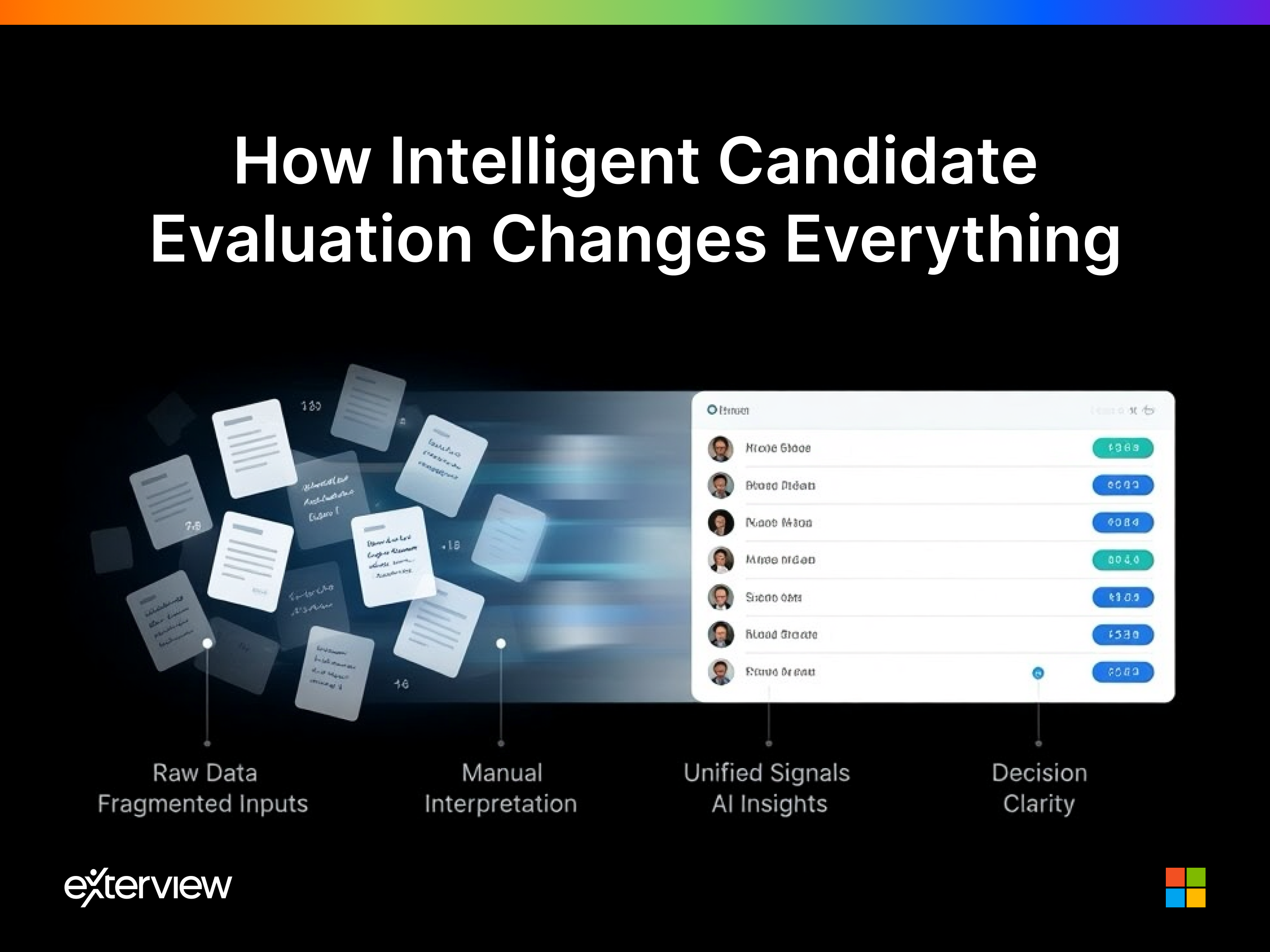
The first phase of the hiring lifecycle is also the most chaotic. Job requisitions arrive with vague requirements. Job descriptions are copied from three years ago. Sourcing is scattered across job boards, LinkedIn campaigns, and agency submissions. And somewhere in that avalanche of applications sits the candidate who will become your next top performer, buried under 3,000 resumes that all look approximately the same.
Phase 1 is not just about filling the pipeline. It is about filling the right pipeline, with the right signal, from the first moment. The organizations that solve Phase 1 correctly never have to fight the downstream problems that plague the rest of the hiring lifecycle.
The Four Failures of Traditional Candidate Evaluation
Before we look at the solution, we need to understand exactly where traditional evaluation breaks down:
Failure 1: Job Definitions Are Aspirational, Not Operational
Most job descriptions are wishlists. They reflect what a hiring manager ideally wants rather than what the role actually requires for success in the first 90 days. This gap means sourcing is misdirected, screening is inaccurate, and the wrong candidates advance while the right ones are filtered out.
Failure 2: Ranking Is Based on Proximity, Not Capability
Keyword matching in ATS systems ranks candidates by how well their resume mirrors the job description, not by their actual capability. Candidates who know how to optimize their resume for software parsing outrank candidates with demonstrably superior skills who simply described them differently.
Failure 3: Screening Is a Bottleneck, Not a Filter
First-round screening interviews, when conducted manually, are a scheduling exercise as much as an evaluation exercise. Teams spend weeks coordinating 30-minute calls that generate inconsistent, unstructured feedback. The bottleneck does not filter the pipeline, it delays it.
Failure 4: Fraud Is Invisible
In an era of AI-assisted applications, ghostwriters, and proxy interview services, the traditional screening process has no detection capability. The resume in front of you may represent the candidate accurately, or it may represent three weeks of AI optimization applied to a candidate who cannot do the job.
Intelligent Candidate Evaluation: The Exterview Framework
Exterview's Phase 1 approach restructures candidate evaluation around a single governing principle: verify capability before investing human attention.
Here is how that principle translates into the platform:
Job Definition Intelligence
Before a single candidate is evaluated, Exterview works with the hiring team to translate role requirements into structured competency frameworks. Not generic job description text. Specific, measurable capability criteria that define what success looks like in this role, in this team, in this organization.
This matters because the quality of your evaluation can never exceed the quality of your criteria. If you do not define what good looks like before you start looking, you will never consistently find it.
AI-Driven Candidate Ranking
Exterview moves beyond keyword matching. Candidate profiles are evaluated against the structured competency framework using multi-signal analysis, assessing not just what candidates list on their resume but the depth, recency, and relevance of their experience across every available signal.
The result is a ranked candidate list that reflects actual fit, not resume optimization skill.
AI Screening Interviews
Exterview deploys AI screening interviews that conduct the first structured evaluation of every candidate at scale, without scheduling delay and without human fatigue.
These are not chatbot exchanges. They are structured, role-specific assessments that:
- Evaluate technical and behavioral competencies against predefined rubrics
- Capture response patterns, communication quality, and problem-solving approach
- Generate structured scores that can be compared across every candidate in the pipeline
- Complete in 24 to 48 hours from application, regardless of pipeline volume
The screening bottleneck is eliminated. The human hiring team receives a ranked, pre-evaluated shortlist.
Fraud Detection
Exterview's fraud detection layer operates throughout Phase 1, identifying anomalies that indicate impersonation, AI-assisted responses, or proxy participation. Identity verification, behavioral biometrics, and response pattern analysis combine to ensure that the candidate being evaluated is the candidate you believe you are evaluating.
In a remote hiring environment, this is no longer optional. It is table stakes.
What Changes When Evaluation Is Intelligent
When Phase 1 operates with intelligence rather than process, the downstream effects are significant:
- Time-to-shortlist drops from weeks to days. AI screening operates continuously, 24/7, eliminating the scheduling delays that make manual screening a bottleneck.
- Shortlist quality improves measurably. Candidates who reach the human interview stage have already demonstrated baseline capability, not just the ability to write a compelling resume.
- Evaluator attention is concentrated. Your recruiters and hiring managers invest their time in the candidates who have already passed a structured capability threshold. Every human interaction is high-value.
- Pipeline data becomes actionable. Because every candidate evaluation generates structured, comparable data, your pipeline analysis shifts from volume metrics to quality metrics.
The Competitive Implication
Top-tier candidates are not patient. The strongest talent in any role category receives multiple concurrent interview offers. They are interviewing your organization at the same time you are interviewing them.
Organizations that can identify, engage, and advance top candidates within 48 hours of application will win talent disproportionately. Organizations that take three weeks to complete a screening round will consistently find that their best candidates accepted offers elsewhere.
Intelligent Phase 1 evaluation is not just an efficiency gain. It is a competitive advantage that compounds across every hire you make.
Exterview transforms Phase 1 from a volume management problem into a signal quality challenge — and then solves the signal quality challenge with intelligent, scalable evaluation infrastructure.

Manish Surapaneni